Solar Street Lighting as an Independent Infrastructure System
Solar street lights are best understood as self-contained power and lighting systems, not merely luminaires without cables. Their value for municipalities and infrastructure planners lies in their ability to deliver stable outdoor lighting without dependence on grid electricity, underground cabling, or substations.
At an engineering level, a solar street light converts solar radiation into electrical energy during daytime, stores that energy, and releases it in a controlled manner at night. When properly designed, this process is predictable, repeatable, and suitable for long-term public infrastructure deployment.
Core System Components and Their Engineering Roles
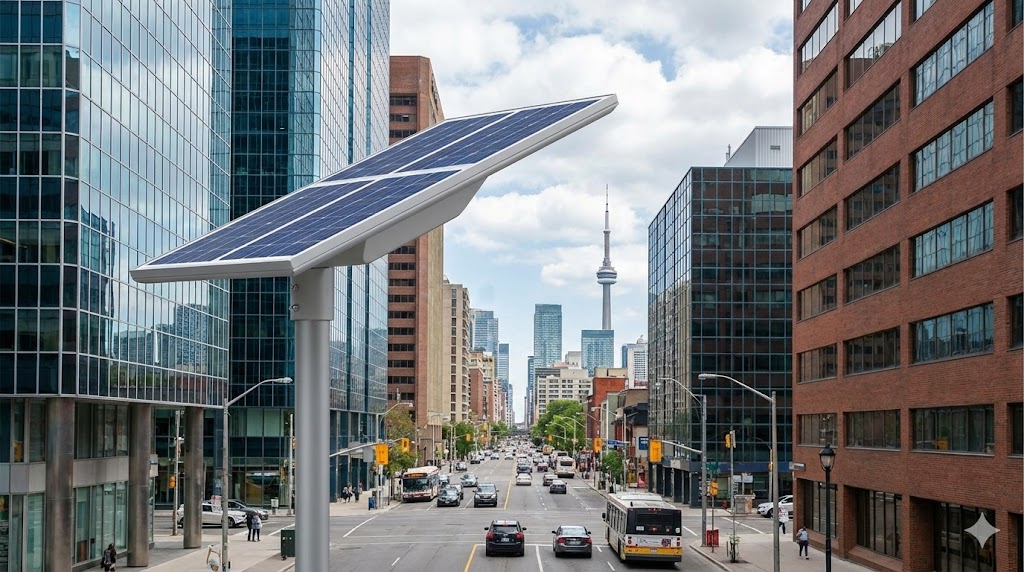
Solar Panel: Primary Energy Generation
The solar panel determines how much energy the system can harvest daily. Most modern installations use monocrystalline or polycrystalline silicon panels.
Monocrystalline panels offer higher conversion efficiency and better performance under partial shading or low irradiance, making them suitable for dense urban areas or regions with seasonal sunlight variation.
Polycrystalline panels provide stable output in consistently sunny environments and are often selected for cost-sensitive projects.
Panel selection directly affects system autonomy during cloudy periods and must be matched to local solar irradiation data.
MPPT Solar Charge Controller: Energy Regulation and Protection
The charge controller manages energy flow between the panel, battery, and LED fixture. Its primary functions include:
Preventing battery overcharging and deep discharge
Controlling lighting schedules (dusk-to-dawn or programmed profiles)
Optimizing power extraction through algorithms such as MPPT (Maximum Power Point Tracking)
In engineering terms, the controller defines system reliability. Poor controller design is a common cause of early failure in low-quality solar street lights.
Battery System: Energy Storage and Nighttime Operation
Modern solar street lights predominantly use lithium-based batteries, especially Lithium Iron Phosphate (LiFePO₄).
Compared with legacy lead-acid batteries, LiFePO₄ batteries provide:
Longer cycle life
Higher depth-of-discharge tolerance
Better thermal stability
Lower maintenance requirements
Battery capacity is calculated based on required lighting hours, power consumption, and the number of consecutive cloudy days the system must withstand.
LED Luminaire: Controlled Light Output
LED fixtures are selected for their high luminous efficacy, long lifespan, and low power consumption. From a system perspective, LED efficiency reduces battery size requirements and extends operational autonomy.
Well-designed optics also help control light distribution, minimizing glare and unnecessary light spill.
Pole and Mounting Structure: Mechanical Stability
The pole and mounting hardware ensure correct panel orientation, wind resistance, and long-term structural safety. For public infrastructure, corrosion resistance and compliance with local wind-load standards are critical considerations.
System Operation in Real-World Conditions
A standard operating cycle involves energy collection during daylight hours, battery charging under controlled parameters, and regulated discharge after sunset.
To improve performance under variable conditions, many systems incorporate:
Adaptive dimming profiles
Motion or presence sensors to reduce energy consumption during low-traffic periods
These measures increase reliability during extended cloudy weather without oversizing system components.
Technical Evolution from Early Prototypes to Smart Infrastructure
Early Development Phase
The photovoltaic effect was identified in the 19th century, but early solar cells had extremely low efficiency. Although conceptual designs for solar-powered lighting appeared as early as 1900, practical deployment was not feasible until silicon-based solar cells emerged in the mid-20th century.
Initial Public Installations
During the energy crises of the 1970s, early solar street lights were deployed in limited public settings. These systems were large, inefficient, and heavily constrained by battery technology and lighting sources such as low-pressure sodium lamps.
LED and Lithium Integration
From the early 2000s onward, LEDs and lithium batteries transformed system viability. Integrated “all-in-one” designs reduced installation complexity, while MPPT controllers improved energy utilization. This period marked the transition of solar street lighting from experimental to functional infrastructure.
Smart City Integration
Since approximately 2016, solar street lights have increasingly been deployed as networked assets, supporting remote monitoring, fault detection, and coordinated operation through communication technologies such as LoRa-based networks. In this phase, the street light becomes a managed system rather than a standalone device.
Current Adoption Trends and Engineering Constraints
Solar street lighting is now widely adopted across Asia-Pacific, Africa, the Middle East, and parts of North America. Key drivers include declining component costs, policy incentives, and the need for rapid infrastructure deployment in off-grid or expanding urban areas.
However, several constraints remain relevant for decision-makers:
Manufacturing impact: Panel and battery production involves material extraction and energy-intensive processes.
Battery lifecycle management: Batteries typically require replacement within several years, making recycling and disposal a planning consideration.
Environmental performance: Temperature extremes, shading, and prolonged overcast conditions affect output and must be addressed during system design.
Procurement risks: Extremely low-cost products often fail to meet performance expectations, resulting in premature system degradation.
From an engineering perspective, system design quality is more decisive than nominal specifications.
Future Development Directions (2026 and Beyond)
Expansion into Multi-Functional Smart Poles
Solar street lights are increasingly being designed as multi-purpose urban nodes, integrating communication equipment, sensors, surveillance systems, and charging infrastructure. This approach maximizes the utility of public right-of-way assets.
AI-Driven Energy and Lighting Management
Artificial intelligence is expected to play a growing role in adaptive lighting control, predictive maintenance, and energy forecasting. These systems adjust output dynamically based on traffic patterns, weather conditions, and historical data.
Advances in Energy Storage
Emerging battery technologies aim to reduce cost and improve safety:
Sodium-ion batteries offer material abundance and improved low-temperature performance.
Solid-state batteries and silicon anodes promise higher energy density with reduced fire risk.
AI-enabled battery management systems improve reliability by anticipating environmental stress factors.
Next-Generation Solar Panels
Technologies such as perovskite-silicon tandem cells and bifacial panels are increasing energy yield per unit area, enabling smaller panels to deliver higher output, particularly in reflective environments.
Solar street lighting has evolved into a mature infrastructure solution capable of meeting modern urban and rural lighting requirements when engineered correctly. Its future lies not only in illumination but in its role as a distributed energy and data platform within smart cities.
For municipalities and infrastructure planners, long-term performance depends on system design, component selection, and realistic environmental assumptions, rather than on headline specifications or upfront cost alone.
Post time: Jan-25-2026


