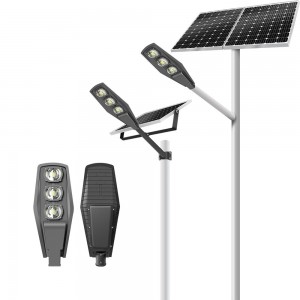
State-of-the-Art Solar Power Street Lighting Expert – BOSUN Solar
According to global search data, the term “solar street light” is increasingly associated with “lumen” and “solar LED street light.” That tells us something important: buyers are becoming more professional. They are no longer only asking “How many watts?” or “How much does it cost?”—they are asking “How bright is it really?” and “Does this system meet my road lighting standard?”
A serious solar street light company must therefore think like an engineering partner, not just a product seller. It needs to design commercial solar street lighting systems around lumen performance, optical distribution, battery autonomy, and long-term reliability, especially when using solar-powered LED street lights and all-in-one solar street light solutions.
This article explains, from a professional and technical perspective, how a high-level solar street light company works, why lumen is a core performance indicator, and how proper system design and solar street light installation make or break project success.
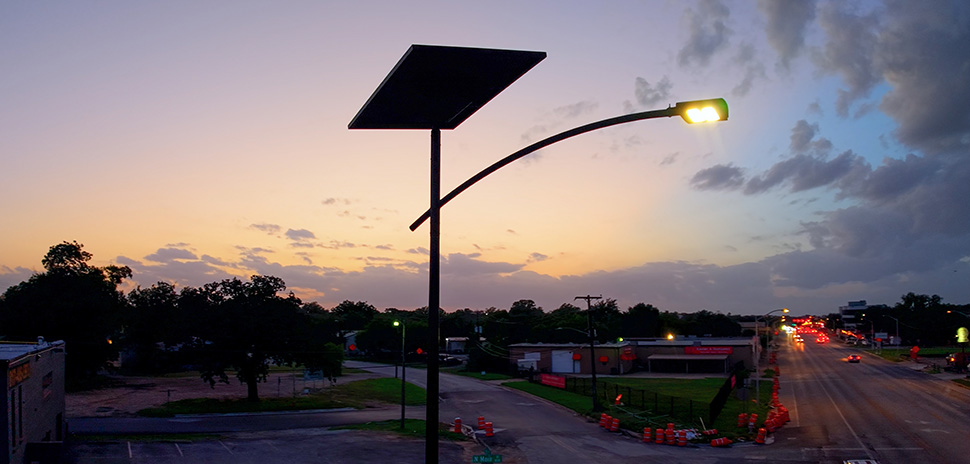
From Watts to Lumens: Why Lumen Rules in Modern Street Lighting
Historically, people specified street lighting in watts: 150W, 250W, or even 400W high-pressure sodium or metal halide. In the era of LEDs and solar power, this thinking is outdated.
- Watt (W) measures power consumption.
- Lumen (lm) measures light output.
A conventional 150W sodium or incandescent lamp and a 60W solar LED street light can produce similar or better road illumination, because the LED system may deliver far more lumens per watt and direct light precisely where it is needed, rather than wasting energy as heat or stray light. The U.S. Department of Energy notes that LEDs can use around 75–90% less energy and last many times longer than traditional incandescent bulbs, which lose most of their energy as heat instead of light.
A professional solar street light company will therefore
- Design based on required lumen on the road surface, not just watts.
- Use IES files and photometric simulations to ensure compliance with road lighting standards.
- Explain to clients that a lower-wattage LED fixture can replace a higher-wattage traditional lamp with superior visibility and energy performance.
Contact BOSUN and get your free lighting design >>
What Defines a Professional Solar Street Light Company?
Not all suppliers of solar products qualify as an engineering-grade solar street light company. The difference lies in methodology and responsibility for actual lighting results.
Application-Driven Design
- For commercial solar street lighting, the company must begin with application data:
- Road type (village road, city street, industrial perimeter road, parking lot, campus, etc.)
- Pole height and spacing
- Required illumination level (lux) and uniformity
- Operation time (e.g., 10–12 hours per night)
- Backup days (battery autonomy for 2–3+ cloudy days)
- Local climate and solar irradiation profile
- Instead of pushing standard models blindly, the company configures:
- Solar powered LED street lights with correct lumen packages
- Panel size matched to local solar potential
- Battery capacity matched to load and autonomy requirements
- Controller type (preferably MPPT) for higher charging efficiency
Engineering Documentation
- A strong company provides:
- Lighting layout and simulation reports
- Electrical schematics for internal connections
- Mechanical drawings of poles and brackets
- Wind resistance and structural checks where needed
This level of detail gives confidence to municipalities, EPC contractors, and commercial buyers that the system is not just a “box product” but a designed lighting solution.
Commercial Solar Street Lighting: Where Performance Really Matters
In many cities, public lighting is one of the biggest electricity loads: international analyses from the UN Environment Copenhagen Centre indicate that street lighting can account for up to 40% of municipal electricity bills and about 15% of global electricity use for lighting, while efficient solutions can cut lighting energy demand by 40–60% with payback periods under three years.
In these scenarios, a professional solar street light company must balance:
Lumen performance: enough brightness and uniformity for safety and visual comfort.
Autonomy and reliability: lights stay on even after several cloudy days.
System efficiency: high-efficacy LED + MPPT controller + efficient solar panel.
Lifetime cost: minimizing electricity, maintenance, and replacement costs over a 10–15 year horizon.
This is why solar powered LED street lights are the standard choice: they deliver high lumen per watt and long service life, which directly supports project ROI and policy targets for energy efficiency.
All-in-One Solar Street Light: Integrated Design for Faster Deployment
The all-in-one solar street light is a compact solution where, are integrated into a single, streamlined unit (sometimes with the battery in a slim separate box, known as “2 in 1 solar street light”).
Benefits in Commercial Applications
- Simplified logistics: one complete unit per pole top.
- Faster installation: fewer components and electrical connections on site.
- Reduced installation cost: less labor and reduced chance of wiring errors.
- Clean appearance: modern form factor that fits contemporary urban design.
Because installation is often one of the biggest cost items in traditional wired street lighting, this integration helps unlock large-scale energy-efficient upgrades. Global policy frameworks, such as EU ecodesign measures for light sources, highlight that more efficient lighting products can save tens of terawatt-hours of electricity annually across member states, reinforcing the value of LED-based solutions in both grid and off-grid applications.
For many commercial roads, parking lots, residential developments, and private projects, an all-in-one system is the most economical and practical choice, especially where speed of deployment matters.
Inside a High-Performance Solar Powered LED Street Light
To understand how a strong solar street light company operates, it’s useful to look at what goes into a well-designed luminaire and system.
LED Light Engine
- High-efficacy LED chips from reputable manufacturers
- Drive current chosen to balance brightness, efficiency, and lifetime
- Color temperature (e.g., 4000–5000K) optimized for road visibility and human comfort
Studies cited by energy agencies consistently show that LEDs use around 75% less energy than incandescent lighting and last far longer, with much lower heat output, making them ideal for outdoor and public applications.
Optics
- Professional secondary lenses designed specifically for roadway lighting
- Beam patterns (Type II, III, V, etc.) chosen based on road geometry and mounting height
- Glare control and improved uniformity to make roads safer and more visually comfortable
Thermal Management
- Robust aluminum heat sinks with sufficient surface area
- Good thermal path from LED PCB to housing
- Design that maintains performance even in hot climates
Well-designed solar LED street lights therefore deliver stable lumen output over many years, not just during initial operation.
Solar Street Light Installation: Process, Quality, and Common Mistakes
Even the best product can fail if solar street light installation is done poorly. A professional company shapes both the product and the installation process.
Site Planning
- Determine pole positions to avoid shading from trees, buildings, or billboards.
- Confirm proper pole height for the selected lumen package and optics.
- Align solar panels to the optimal azimuth and tilt angle for local solar conditions.
Mechanical Installation
- Ensure foundation strength and correct anchor bolt layout.
- Proper torque on all structural fasteners to withstand wind loads.
- Incorporate anti-theft design for panels and battery compartments where theft risk is high.
Electrical & System Setup
- Connect solar panel, battery, controller, and LED according to the manufacturer’s schematics.
- Set lighting modes (dimming, full-brightness hours, late-night energy-saving mode).
- Check polarity, cable routing, and tightness of terminals.
- Commissioning
- Perform night testing after installation to confirm brightness and control logic.
- Monitor for several nights or weeks to detect any unexpected shutdowns.
- Common mistakes that a quality solar street light company helps prevent include:
- Under-sizing panels or batteries just to lower price
- Installing panels in shaded positions or at incorrect angles
- Selecting battery technologies unsuited to local temperatures
- Ignoring seasonal variation and long rainy or dusty periods
Lumen-Centric Design: Turning Data into Real-World Visibility
How many lumens does each solar powered LED street light deliver?
What is the average illuminance (lux) on the road surface?
How does this compare to previous grid-powered fixtures?
A professional solar street light company such as BOSUN Solar would do:
Starts from the relevant road lighting standard (minimum average lux, uniformity, glare limits).
Selects LED wattage and optics to meet those targets efficiently.
Sizes the solar panel and battery based on lumen output, operation hours, and autonomy needs.
Verifies results using simulations and field experience, rather than relying on nominal wattage alone.
Why Working with a Specialized Solar Street Light Company Matters?
In a market full of generic solar product sellers, working with a specialized solar street light company offers clear advantages:
Technical consultation: proper system sizing instead of one-size-fits-all models.
Proven experience in commercial solar street lighting for roads, campuses, and industrial areas.
Deep knowledge of both customized separated systems and all in one solar street light solutions.
Guidance and documentation for correct solar street light installation, tailored to local climates and codes.
Long-term spare parts supply and after-sales support.
Real-world LED street lighting conversions in major cities illustrate what is at stake. Los Angeles, for example, converted most of its street lighting to LEDs and reports around 64% energy savings, roughly 114 GWh of electricity saved per year, and about US$10 million in annual energy and maintenance savings, alongside significant CO₂ reductions.
If this is what a well-designed LED upgrade can do on a grid-connected system, the combination of LED efficiency and off-grid solar power in commercial solar street lighting has even greater potential to reduce municipal costs and emissions, especially in areas where grid electricity is unreliable or expensive.
FAQs of Professional Solar Street Light Company
What makes a solar street light company “engineering-grade”?
An engineering-grade company offers full project design rather than just catalog sales. It provides photometric calculations, correct system sizing for panels and batteries, and clear documentation. It prioritizes lumen performance, reliability, and long-term cost of ownership over short-term price competition.
What is the difference between a solar street light and a solar LED street light?
A solar street light is any street lighting system powered by solar energy. A solar LED street light specifically uses LED as the light source, which is far more efficient and longer-lasting than older lamps such as incandescent or sodium vapor. This enables better lighting quality with far lower energy consumption.
Why are commercial solar street lighting projects moving away from watt-based specifications?
Because watts measure energy use, not brightness. Modern projects specify systems by lumens and road surface lux levels, ensuring that safety and visibility requirements are met while minimizing energy and component sizes.
Where are all in one solar street light systems most suitable?
They are ideal for commercial compounds, residential streets, secondary roads, industrial areas, tourist zones, and any site where fast deployment, low installation cost, and clean aesthetics are important.
How important is installation quality in solar street light performance?
Very. Even high-quality products will underperform if panels are shaded, angled incorrectly, or under-sized for the local climate. Proper solar street light installation ensures stable operation, protects battery life, and avoids premature failures.
Are solar powered LED street lights suitable for main roads and highways?
Yes, provided they are correctly sized and use professional roadway optics. Many regions already deploy high-power solar LED street lights on major roads where grid extension is difficult or where energy-efficiency and resilience are strategic priorities.
Post time: Dec-15-2025